

American Jiu-Jitsu vs. Brazilian Jiu-Jitsu: Why We Train Differently
How we train American Jiu-Jitsu — and why it’s different from Brazilian Jiu-Jitsu.
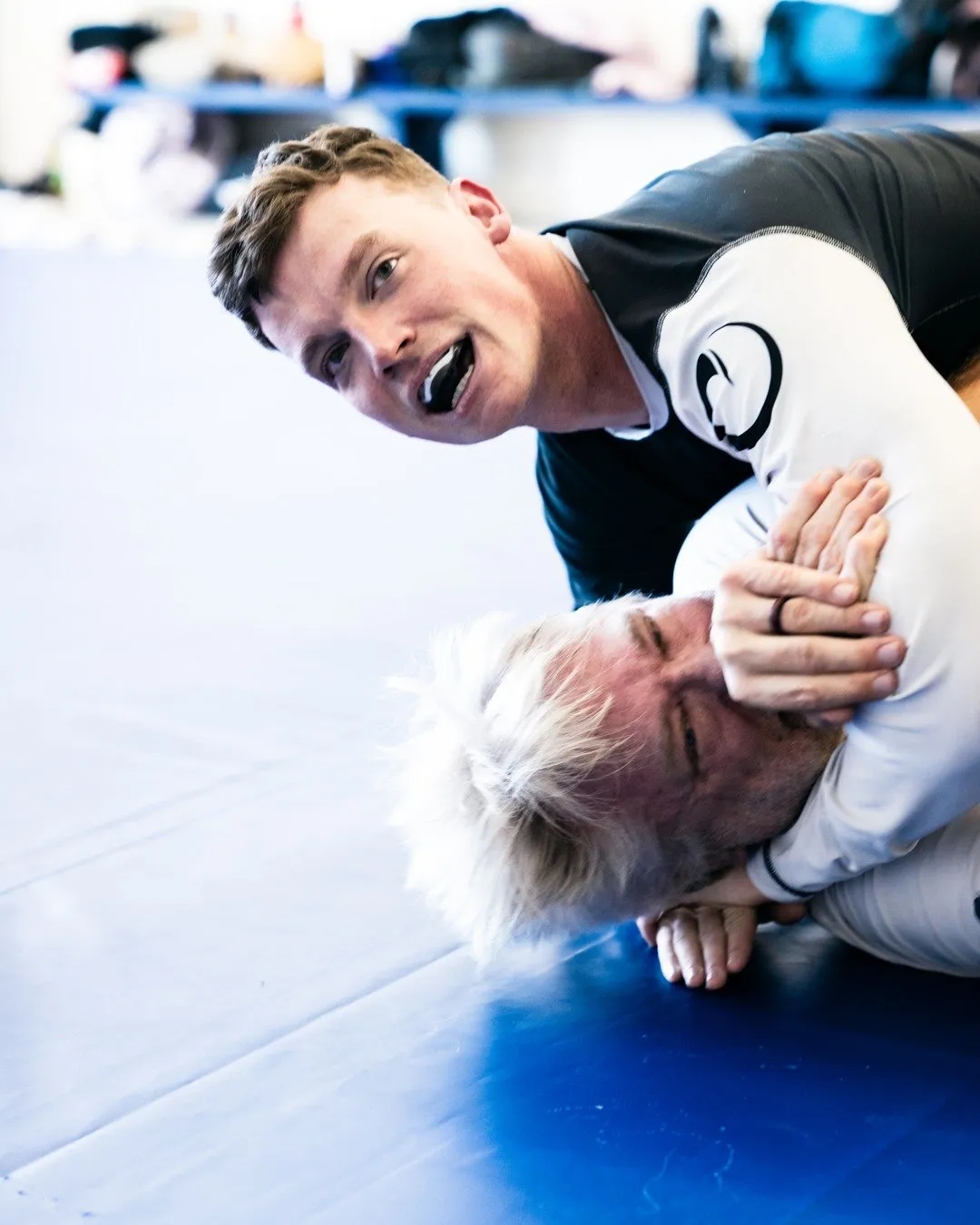
You are likely here because you searched for Brazilian Jiu-Jitsu in Boise or Mountain Home. You are looking for a place to train, get fit, and challenge yourself. You’ve found the right room—but you will quickly notice we do things a little differently. We train American Jiu-Jitsu.
So, what is the difference between American and Brazilian Jiu-Jitsu? In 30 seconds: American Jiu-Jitsu provides the exact same highly effective submission grappling, but stripped entirely of unnecessary ego, dogma, and strict traditional hierarchy. We focus on complete grappling (integrating heavy wrestling and judo), cultivate a culture of approachable coaches rather than unreachable gurus, and maintain an unwavering mission to serve your personal goals. We don’t ask you to worship a lineage. We ask you to show up, respect the room, and do the work. Whether you are brand new to martial arts or a veteran of BJJ looking for a better culture, this is a place to grow.
The Lineage — Japan, Brazil, and Now America
To truly understand what American Jiu-Jitsu is, you have to understand the history of jiu-jitsu itself. It is a story of continuous evolution, pressure-testing, and adaptation.
The roots of the art are Japanese. In the late 19th century, Jigoro Kano developed judo from traditional Japanese jiu-jitsu, creating a highly effective system that was originally referred to globally as “Kano jiu-jitsu.” In the early 1900s, a Japanese master named Mitsuyo Maeda carried this incredible art across the globe to Brazil. There, he eventually taught it to Carlos Gracie.
The Gracie family—along with the Machados and other pioneers—took the Japanese framework, adapted the techniques, relentlessly pressure-tested them in real fights, contributed their own brilliant innovations, and renamed the system Brazilian Jiu-Jitsu. It was an incredible rebranding and refinement of a Japanese art that ultimately changed martial arts forever.
Over the last few decades, the art has continued to evolve. Americans have driven some of the biggest recent innovations in grappling, largely by integrating our own deeply rooted wrestling traditions with elite submission mechanics.
American Jiu-Jitsu isn’t invented from thin air, and it isn’t a shot at anyone. It is exactly what every great chapter of this art has done: honor where it came from, and stand confidently in its own name. We honor Japan, where the foundation began. We respect Brazil, where the Gracies made it shine. And we claim our own name because we’ve built our academy around our own core values—excellence, trust, compassion, and stewardship. There is no ego, no gatekeeping, and no pedestals here.
“Japan built it. Brazil adapted it and renamed it. America is writing the next chapter.”
What Makes American Jiu-Jitsu Different
While the mechanical submissions might look similar to traditional BJJ, the culture, the curriculum, and the physical application are where we clearly diverge.
Complete Grappling — Takedowns, Not Just Guard
In many traditional academies, the fight starts on the knees, or players immediately pull guard to fight from their backs. We believe in complete, functional grappling. American Jiu-Jitsu fully integrates the highest-percentage techniques from wrestling and judo into the submission game. You will learn how to take someone down, dictate the pace, and control the physical space from the feet all the way to the floor.
Your Goals Drive the Training
We run training programs, not transactional sign-ups. You aren’t here to serve the art; the art is a tool designed to serve you. Whether your goal is self-defense, athletic competition, physical fitness, or profound personal transformation, our curriculum is designed to help you execute. We provide clarity, simplicity, and actionable steps so you know exactly how to progress week after week.
Coaches, Not Gurus — A Flat, Ego-Free Room
You will not find a “Professor” looking down from a pedestal here. We are coaches. A coach’s fundamental job is to elevate you, challenge your assumptions, strengthen your physical and mental ideas, and build you up. Our communication is emotionally intelligent, direct, and leadership-focused. The training room is flat—we are all on the same team, sweating together and working toward excellence.
Respect, Not Ritual
In some BJJ schools, you’ll find strict rules about bowing to pictures on the wall, refusing to wash your belt, or navigating complex hierarchies before you are even allowed to speak to an instructor. We replace arbitrary ritual with authentic respect. You show respect by how hard you train, how well you protect your training partners, and how you carry yourself in and out of the academy.
Come Ready to Work — No Gatekeeping
Nobody owns the mats. There is no permission-based rolling where you have to sit on the wall and wait for a higher belt to formally invite you to train. We do not gatekeep knowledge or rounds. If you show up with compassion for your partners and a willingness to work hard, you belong in the mix immediately.
American Jiu-Jitsu vs. Brazilian Jiu-Jitsu, Side by Side
| Feature | Traditional BJJ | American Jiu-Jitsu at Egley Train |
|---|---|---|
| Standup / takedowns | Often secondary | Core — wrestling + judo integrated |
| Focus | The art / the system | The student’s goals |
| Coach culture | Professor / hierarchy | Coaches, flat & ego-free |
| Training access | Permission-based rolling common | Roll with anyone, no gatekeeping |
| Ritual | Belt reverence | Respect for the room & each other |
| Lineage | Brazilian | Rooted in history, built for results |
Train It Yourself — Free Private Lesson in Boise & Mountain Home
Reading about the culture is one thing; feeling the energy in the room is another. The best way to understand the difference between Boise jiu jitsu options is to step onto the mats and experience it firsthand.
Whether you are looking for adult classes or kids programs, we have world-class facilities in both Boise and Mountain Home, Idaho, ready to welcome you. We want to start by learning about you. Let’s sit down for a conversation about your goals, followed by a one-on-one introduction to the academy and our systems.
Frequently Asked Questions
Is American Jiu-Jitsu the same as BJJ?
Mechanically, they share many of the same foundational submissions, sweeps, and methods of positional control. Culturally and philosophically, they differ significantly. We strip away the dogma, hierarchy, and traditional rituals of Brazilian Jiu-Jitsu, integrating a heavier emphasis on wrestling, takedowns, and a flat, coach-driven environment focused on your personal growth.
Is American Jiu-Jitsu a real martial art?
Absolutely. Just as Kano jiu-jitsu evolved from older Japanese systems, and Brazilian Jiu-Jitsu evolved from Kano’s teachings, American Jiu-Jitsu is the next logical evolution of the art. It is a fully realized, pressure-tested system of complete grappling that emphasizes real-world effectiveness and physical control.
Where does jiu-jitsu come from?
The roots of the art begin in Japan. It was later brought to Brazil in the early 20th century by Mitsuyo Maeda, where the Gracie family adapted, refined, and renamed it. Today, America is writing the next chapter with American Jiu-Jitsu, honoring the past while pushing the physical and cultural boundaries forward.
Do you teach Brazilian Jiu-Jitsu?
We teach American Jiu-Jitsu. If you are searching for BJJ in Boise or Mountain Home, you will find that our grappling system provides the exact same high-level self-defense and submission skills you are looking for, but delivered through a much different culture and training methodology.
I’ve trained BJJ before — will I fit in?
Yes. Many of our students have prior experience in traditional Brazilian Jiu-Jitsu. You will find a welcoming, ego-free room where your past experience is highly respected. You won’t have to navigate any complex politics or hierarchy—you can immediately jump in, connect with the community, and get to work.
Where can I train — Boise or Mountain Home?
We operate mission-driven training programs in both Boise and Mountain Home, Idaho. Both locations run the exact same unified curriculum, offering empowering classes for both adults and kids.